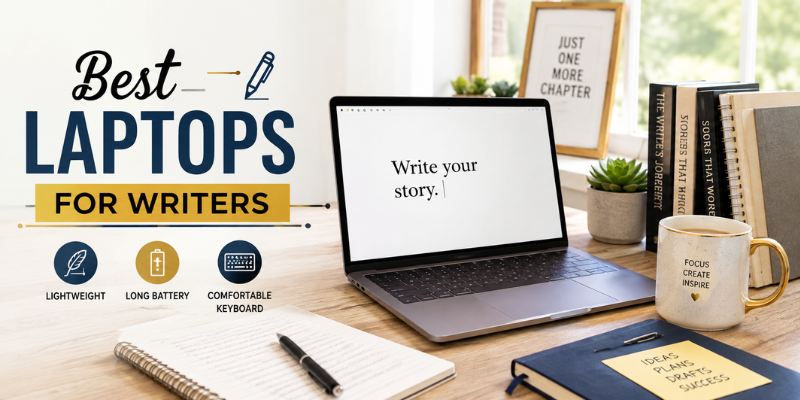

Finding the best laptops for writers is less about chasing the most powerful processor and more about choosing a machine that makes writing comfortable. Writers can spend hours typing, researching, editing documents, and managing dozens of browser tabs, so the keyboard, display, battery, and overall comfort matter enormously.
A good writing laptop should feel reliable without getting in the way of your ideas. Whether you are working on a novel, blog posts, essays, articles, or freelance projects, the right laptop can make long writing sessions considerably easier.
The good news is that you do not need a high-end workstation to write effectively. Many lightweight laptops provide excellent performance for word processing, research, communication, and everyday productivity.
What Makes the Best Laptops for Writers?
The best laptops for writers usually share a few important characteristics. A comfortable keyboard should be near the top of the list because writers interact with it constantly.
Key travel, spacing, responsiveness, and overall layout can make a noticeable difference during long sessions. A keyboard that feels comfortable for ten minutes may not feel nearly as good after three or four hours of continuous typing.
Battery life is another major consideration. Writers often work in cafés, libraries, offices, trains, or other places where a power outlet is not always convenient. A laptop that can comfortably handle a full working day gives you more freedom.
Weight matters too. If you regularly carry your laptop between home and work, a thin and lightweight model can be much more practical than a large machine. Current laptop guides for writers similarly emphasize keyboards, battery life, weight, and screen quality over unnecessary performance specifications.
Best Writing Laptops for Long Typing Sessions
For writers, the keyboard can be more important than the processor. You may never notice the difference between two modern laptop CPUs while writing a document, but you will notice an uncomfortable keyboard after thousands of keystrokes.
The Apple MacBook Air is a strong all-round option for writers who prefer macOS. Current 2026 laptop coverage places the 13-inch MacBook Air with the M5 chip among the leading choices because of its combination of portability, performance, battery life, and quiet operation.
Windows users have several excellent alternatives. Lenovo’s ThinkPad range has long attracted people who prioritize keyboard feel and practical design. The ThinkPad X1 Carbon is particularly appealing to writers who want a lightweight business laptop without giving up a comfortable typing experience.
The Microsoft Surface Laptop is another option for users who want a premium Windows experience. Its clean design, comfortable keyboard, and high-quality display make it suitable for writing, research, and everyday productivity.
Laptop Display and Eye Comfort for Writers
A laptop screen is easy to overlook when shopping for a writing machine. However, writers can spend many hours looking at text, so display quality deserves serious attention.
A sharp display makes small text easier to read. Good brightness and contrast can also make a difference when working in different environments.
Screen size is a matter of personal preference. A 13- or 14-inch laptop is generally easier to carry, while a 15- or 16-inch display gives you more room for documents, research windows, and side-by-side applications.
Resolution is not everything, though. A high-resolution screen that is difficult to read because of excessive reflections may be less useful than a slightly lower-resolution matte display.
If you regularly edit long documents, also consider the laptop’s scaling options. Being able to increase text size without making everything look blurry can make extended writing sessions more comfortable.
Battery Life and Portability for Writers
Portability is one of the biggest reasons writers choose laptops instead of desktop computers. You can move from your office to a coffee shop, library, or meeting without changing your entire setup.
Battery life therefore deserves attention. A laptop that needs to be plugged in after only a few hours can become frustrating for someone who likes to write away from a desk.
Apple’s current MacBook Air is particularly strong in this area, while several Windows laptops also provide excellent endurance. Current laptop testing and buying guides continue to identify lightweight, efficient laptops as strong choices for people who need to work away from a desk.
Weight should be considered alongside battery life. A laptop weighing a little less may not sound important on paper, but the difference becomes noticeable when you carry it every day.
A comfortable carrying size can also encourage you to take the laptop with you instead of leaving it at home.
Storage, RAM, and Performance for Writing
Writers generally do not need an extremely powerful laptop. Word processors, web browsers, email applications, note-taking tools, and research websites are not especially demanding compared with video editing or gaming.
For a modern writing laptop, 16GB of RAM is a comfortable target for people who regularly work with many browser tabs and applications. Lighter users may be perfectly satisfied with less, depending on the operating system and workload.
Storage requirements are also relatively modest. A 512GB SSD is enough for many writers, while 1TB provides additional room for large research collections, photos, videos, backups, and other files.
An SSD is strongly preferable to an older mechanical hard drive. It allows the operating system and applications to start quickly and makes everyday file management feel much more responsive.
Cloud storage can also complement local storage. Keeping important manuscripts and documents synchronized with a trusted cloud service can provide additional protection against hardware failure.
MacBook, Windows, or Chromebook for Writers?
The operating system is largely a personal choice, but it can affect which writing applications and workflows are available.
macOS is popular with many writers because of its clean interface, strong battery life on Apple Silicon laptops, and integration with other Apple devices. The MacBook Air is particularly attractive when portability and quiet operation are priorities. Current 2026 coverage continues to position the M5 MacBook Air as a leading general-purpose laptop.
Windows offers a much wider selection of hardware and price points. Writers can choose from lightweight premium laptops, business machines, convertibles, and affordable models. ThinkPad, Surface, Dell, HP, and ASUS all offer options suitable for writing.
Chromebooks can also work well for writers who mainly use browser-based tools such as Google Docs. Their simple operating system and relatively affordable pricing can make them attractive to students and people who want a straightforward writing device.
The best choice depends on the applications you use, your preferred ecosystem, and how much flexibility you need.
How to Choose the Best Laptop for Your Writing Style
The right laptop depends on what kind of writing you do.
A novelist who spends most of the day writing manuscripts may prioritize keyboard comfort, battery life, and a distraction-free display. A freelance content writer may need additional performance for research, image editing, video calls, and multiple browser tabs.
Students may place more emphasis on price, portability, and battery life. Journalists or travel writers may want something particularly lightweight and durable because they frequently work away from home.
If you write at a desk most of the time, a larger screen may be worth considering. If you move between locations regularly, a compact 13- or 14-inch laptop could be a better fit.
Before buying, think about your actual working habits rather than simply comparing processor numbers. The best laptops for writers are the ones that remove friction from the writing process and let you concentrate on your work.
FAQs About the Best Laptops for Writers
What are the best laptops for writers?
The best laptops for writers are usually lightweight machines with comfortable keyboards, long battery life, sharp displays, and enough performance for everyday productivity. The MacBook Air, ThinkPad X1 Carbon, and Microsoft Surface Laptop are examples of models that suit different writing preferences.
Is the MacBook Air good for writers?
Yes. The MacBook Air is particularly well suited to writers who value portability, quiet operation, battery life, and a high-quality display. Current 2026 coverage identifies the M5 MacBook Air as a strong all-round laptop.
How much RAM does a writer need?
For most writers, 16GB of RAM is a comfortable choice. It provides enough headroom for writing applications, web browsers, research tabs, video calls, and other everyday programs. Users with lighter workloads may need less.
Is a Chromebook good for writing?
A Chromebook can be an excellent writing laptop if your workflow mainly uses web-based applications such as Google Docs. It can be particularly attractive for students and writers who want a simple and affordable device.
What should writers prioritize when buying a laptop?
Writers should generally prioritize keyboard comfort, battery life, portability, display quality, storage, and reliability. Processor performance is important, but most writing tasks do not require an extremely powerful CPU or dedicated graphics card.
Conclusion
Choosing the best laptops for writers is ultimately about comfort and reliability rather than having the biggest specifications sheet. A responsive keyboard, sharp display, strong battery life, and portable design can make a much bigger difference to a writer’s daily workflow.
MacBook Air models are excellent options for people who prefer macOS, while ThinkPad and Surface laptops provide compelling Windows alternatives. Chromebooks can also be practical for writers who mainly work online.
Think about where you write, how long you type each day, which applications you use, and how often you travel with your laptop. The right combination of these features will help you choose a machine that supports your writing instead of distracting you from it.
Stay in touch to get more updates & alerts on site marketingdirecto.co.uk! Thank you