
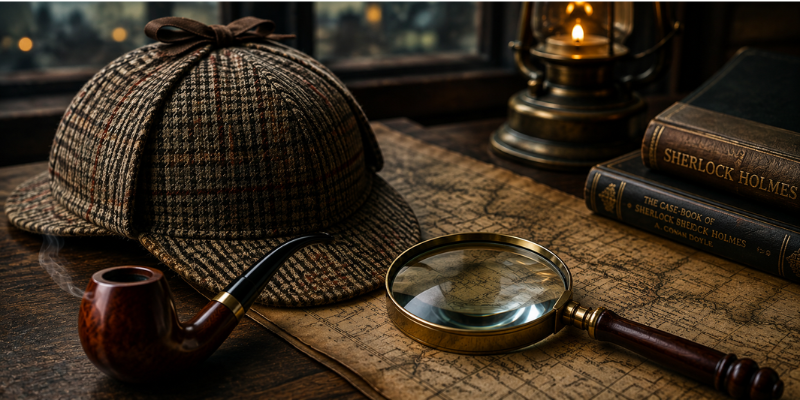

The phrase deerstalker pipe magnifying glass immediately brings Sherlock Holmes to mind. These three objects have become some of the most recognizable visual shorthand for the famous fictional detective, even though the popular image does not perfectly match the original stories.
A deerstalker cap, curved pipe, and magnifying glass can instantly communicate mystery, deduction, and Victorian detective fiction without showing the character’s face.
But there is an interesting story behind this familiar combination. Some elements came from the original Holmes stories, while others became strongly associated with the character through illustrations, stage performances, films, and later popular culture.
Why the Deerstalker, Pipe and Magnifying Glass Mean Sherlock Holmes
The connection between these objects and Sherlock Holmes developed gradually rather than appearing as a complete package in Arthur Conan Doyle’s original writing.
The British Library notes that the pipe, magnifying glass, and deerstalker hat became part of the familiar Holmes image over time. The character was originally created in the late nineteenth century, but later adaptations helped establish the visual identity most people recognize today.
Stanford’s Sherlock Holmes project makes an important distinction: Holmes did use a magnifying glass occasionally, but the famous combination of deerstalker, calabash pipe, and magnifying glass is largely a product of popular culture.
That difference is what makes the imagery so interesting. The objects are historically connected to Holmes, but not always in the way modern illustrations suggest.
The Deerstalker Cap
The deerstalker is perhaps the most recognizable part of the traditional detective costume.
Illustrator Sidney Paget played an important role in shaping the visual appearance of Holmes. The cap became associated with the character through illustrations and later adaptations, despite Holmes not routinely wearing it throughout the original stories.
Its practical outdoor appearance also suited the image of a detective who might travel outside London while investigating a case.
Over time, the hat became so closely connected with Holmes that a simple silhouette of a deerstalker can suggest the detective without any additional character details.
The Detective Pipe and Its Changing Image
The pipe is another major part of the classic Sherlock Holmes look.
However, there is no single pipe that accurately represents every version of Holmes. Different adaptations have used different shapes and materials, including straight pipes and curved pipes.
Actor William Gillette was particularly influential in shaping the stage version of Holmes. His curved briar pipe became an enduring part of the character’s visual identity. One practical reason was that a curved pipe made it easier for Gillette to speak while holding it.
Later portrayals introduced other styles, including the famous calabash associated with Basil Rathbone’s portrayal. This demonstrates how an actor’s interpretation can influence the public’s understanding of a literary character.
Why the Pipe Became a Detective Symbol
The pipe helped create an image of Holmes as thoughtful and analytical.
A detective sitting quietly with a pipe suggests someone examining a problem rather than rushing toward a conclusion. This visual idea became especially effective in posters, illustrations, theatrical performances, and film.
The pipe therefore became more than a smoking accessory. In popular culture, it became part of the visual language of deduction.
The Magnifying Glass and Sherlock Holmes
Of the three objects, the magnifying glass has a particularly strong connection with investigation.
Holmes examines physical evidence, studies details, and notices clues that other people overlook. A magnifying glass naturally communicates this process to an audience.
Stanford’s Sherlock Holmes project confirms that Holmes did occasionally use a magnifying glass in the original stories.
That makes the magnifying glass different from some of the more exaggerated elements of the popular costume. It has a genuine connection to Holmes’s investigative methods, even though modern depictions may use it much more prominently than the books did.
Why a Magnifying Glass Works So Well Visually
The object is immediately understandable. Even someone unfamiliar with the stories can recognize a magnifying glass as a symbol of investigation.
When combined with a deerstalker and pipe, it creates a compact visual message: detective, mystery, evidence.
That is why the combination continues to appear in costumes, illustrations, posters, educational materials, puzzles, and mystery-themed decorations.
Deerstalker Pipe Magnifying Glass in Popular Culture
The deerstalker pipe magnifying glass combination has become shorthand for Sherlock Holmes across generations.
The image has appeared in stage productions, films, books, cartoons, advertising, artwork, and novelty merchandise. It is so recognizable that artists can sometimes depict only the objects rather than the detective himself.
The British Library describes these familiar elements as part of the visual legacy surrounding Holmes.
Different adaptations have also deliberately changed the formula. Some modern versions remove the deerstalker or traditional pipe to create a more contemporary interpretation.
For example, the 2009 film starring Robert Downey Jr. and Jude Law avoided several of the most predictable Holmes visual clichés, illustrating how modern filmmakers can reinterpret a character without relying on the traditional costume.
Why the Classic Combination Survives
The reason is simple: it communicates instantly.
A detailed portrait requires the viewer to recognize a face. Three familiar objects can achieve the same result in a fraction of a second.
This makes the imagery particularly effective for logos, posters, costumes, book covers, illustrations, and themed events.
How to Use the Classic Detective Theme
If you are creating artwork inspired by Victorian detective fiction, the three objects can provide a strong starting point.
A deerstalker can establish the character silhouette. A pipe adds an old-fashioned intellectual quality, while a magnifying glass communicates investigation.
You do not necessarily need to reproduce a specific film or illustration. Original artwork can combine these elements with other period details such as notebooks, fountain pens, pocket watches, maps, or newspapers.
For a modern design, simplifying the objects into clean silhouettes can make the concept work especially well for icons and logos.
Creating a Sherlock-Inspired Visual Style
Color also changes the impression.
Muted browns, dark greens, charcoal, cream, and burgundy can create a traditional Victorian atmosphere. Black-and-white artwork can produce a more classic newspaper or mystery-book appearance.
The goal should be recognition without overcrowding the design. A few carefully chosen objects often communicate the theme better than a scene filled with unnecessary details.
Why These Sherlock Holmes Symbols Still Matter
The enduring popularity of these objects shows how visual storytelling can transform literary characters.
Arthur Conan Doyle created Sherlock Holmes as a brilliant consulting detective, but illustrators, actors, filmmakers, and artists helped build the visual identity that modern audiences recognize. The deerstalker, pipe, and magnifying glass became part of that larger cultural evolution.
The important point is that the popular image is not entirely fictional or entirely historical. It is a mixture of details from the original stories and later interpretations.
That is precisely why the imagery remains so effective. It feels authentic while also being instantly recognizable.
FAQs About the Classic Sherlock Holmes Look
What does the deerstalker pipe magnifying glass combination represent?
It represents Sherlock Holmes and the broader idea of detective investigation. The three objects have become visual shorthand for mystery, observation, deduction, and Victorian detective fiction.
Did Sherlock Holmes actually wear a deerstalker?
The deerstalker became strongly associated with Holmes through illustrations and adaptations, but he did not routinely wear one throughout the original stories. Stanford’s Sherlock Holmes project specifically notes that Holmes wore a cap only once in the original stories.
Did Sherlock Holmes use a magnifying glass?
Yes. Holmes occasionally used a magnifying glass while investigating evidence in the original stories. Its importance was later amplified by popular depictions of the detective.
What type of pipe is associated with Sherlock Holmes?
There is no single definitive Holmes pipe. Different portrayals have used different designs. William Gillette helped popularize a curved briar pipe, while later portrayals, particularly Basil Rathbone’s, became associated with the calabash style.
Why are these objects still associated with Sherlock Holmes?
They are simple, recognizable visual symbols. A deerstalker suggests the classic detective, a pipe suggests contemplation, and a magnifying glass suggests examination of clues. Together, they communicate the Holmes concept almost instantly.
Conclusion
The deerstalker pipe magnifying glass combination is one of the most recognizable visual representations of Sherlock Holmes. Yet its history is more interesting than the familiar costume suggests.
Some elements have genuine roots in the original stories, while others became famous through illustrators, actors, films, and popular culture.
The lasting lesson is that a character’s visual identity can evolve far beyond the original page. In Holmes’s case, three simple objects became a universal symbol of mystery, observation, and clever deduction.
Final Line
Stay in touch to get more updates & alerts on site marketingdirecto.co.uk! Thank you